

Join us at ,
Event information ›Understanding PLGD-1
a systemic protein deficiency

Patients with PLGD-1 have both abnormally low plasminogen levels and reduced plasminogen activity, resulting in the formation of fibrin-rich lesions on mucous membranes throughout the body.3
MORE
Understanding PLGD-1
a systemic protein deficiency
PLGD-1 is an autosomal recessive disorder caused by mutations in both copies of the gene for plasminogen.4
Lesions due to PLGD-1 can form spontaneously but are typically triggered by local infection, irritation, injury, or surgical intervention.3
These lesions often affect multiple organs, including the eyes, mouth, ears, respiratory tract, and more, with symptoms resembling more common conditions. This, along with the rarity of the disease and variability in the initial point of care, contributes to the frequent misdiagnosis or underdiagnosis of PLGD-1.5
Explore the systemic impact
What is RYPLAZIM?
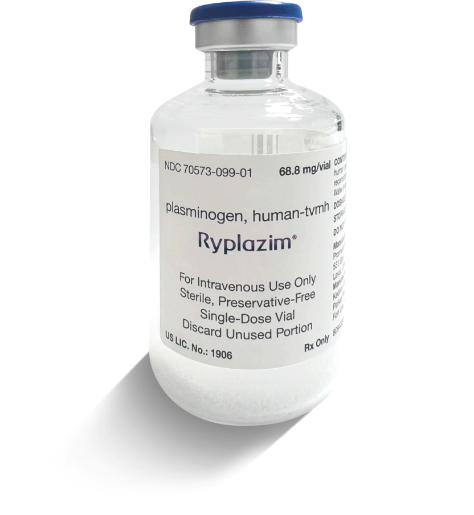
Systemic plasminogen replacement therapy for long-term treatment of PLGD-11
MORE
What is RYPLAZIM?
RYPLAZIM is the first and only FDA-approved plasma-derived treatment indicated for patients with plasminogen deficiency type 1 (PLGD-1).1,6
By temporarily replacing plasminogen in the blood, RYPLAZIM restores fibrinolytic activity. This allows the body to break fibrin down into fibrin degradation products (FDPs) and thus resolve and control fibrin-rich lesions caused by PLGD-1.1-3,7
Learn more about RYPLAZIM
INDICATIONS AND USAGE
RYPLAZIM® (plasminogen, human-tvmh) is a plasma-derived human plasminogen indicated for the treatment of patients with plasminogen deficiency type 1 (hypoplasminogenemia).
IMPORTANT SAFETY INFORMATION
CONTRAINDICATIONS:
RYPLAZIM is contraindicated in patients with known hypersensitivity to plasminogen or other components of RYPLAZIM.
WARNINGS AND PRECAUTIONS:
- Bleeding: RYPLAZIM administration may lead to bleeding at active mucosal disease-related lesion sites or worsen active bleeding not related to disease lesions. Discontinue RYPLAZIM if serious bleeding occurs. Monitor patients during and for 4 hours after infusion when administering RYPLAZIM to patients with bleeding diatheses and patients taking anticoagulants, antiplatelet drugs, or other agents which may interfere with normal coagulation.
- Tissue Sloughing: Respiratory distress due to tissue sloughing may occur in patients with mucosal lesions in the tracheobronchial tree following RYPLAZIM administration. Please monitor appropriately.
- Transmission of Infectious Agents: RYPLAZIM is made from human plasma and therefore carries a risk of transmitting infectious agents, e.g., viruses, the variant Creutzfeldt-Jakob disease (vCJD) agent, and theoretically, the Creutzfeldt-Jakob Disease (CJD) agent.
- Hypersensitivity Reactions: Hypersensitivity reactions, including anaphylaxis, may occur with RYPLAZIM. If symptoms occur, discontinue RYPLAZIM and administer appropriate treatment.
- Neutralizing Antibodies: Neutralizing antibodies (inhibitors) may develop, although they were not observed in clinical trials. If clinical efficacy is not maintained (e.g., development of new or recurrent lesions), determine plasminogen activity trough levels in plasma.
- Laboratory Abnormalities: Patients receiving RYPLAZIM may have elevated blood levels of D-dimer. D-dimer levels will lack interpretability in patients being screened for venous thromboembolism (VTE).
ADVERSE REACTIONS:
The most frequent (incidence ≥ 10%) adverse reactions in clinical trials were abdominal pain, bloating, nausea, fatigue, extremity pain, hemorrhage, constipation, dry mouth, headache, dizziness, arthralgia, and back pain.
To report SUSPECTED ADVERSE REACTIONS, contact KEDRION at 1-855-427-6378 or the FDA at 1-800-FDA-1088 or www.fda.gov/medwatch.
Click here for the RYPLAZIM Full Prescribing Information.
This site is intended for residents of the US only.
References:
1. RYPLAZIM [prescribing information]. Kedrion Biopharma Inc. 2024.
2. Shapiro AD, McDaniel H, Decker RW, et al. Safety and efficacy of long-term treatment of type 1 plasminogen deficient patients with intravenous plasminogen replacement therapy. Haemophilia. 2025;31(3):477-484.
3. Schuster V, Hügle B, Tefs K. Plasminogen deficiency. J Thromb Haemost. 2007;5(12):2315-2322.
4. Tefs K, Gueorguieva M, Klammt J, et al. Molecular and clinical spectrum of type 1 plasminogen deficiency: a series of 50 patients. Blood. 2006;108(9):3021-3026.
5. Shapiro AD, Nakar C. How I treat type 1 plasminogen deficiency. Blood. 2025;145(25):2954-2965.
6. FDA approves first treatment for patients with plasminogen deficiency, a rare genetic disorder. US Food & Drug Administration. Updated June 4, 2021. Accessed December 10, 2025. https://www.fda.gov/news-events/press-announcements/fda-approves-first-treatment-patients-plasminogen-deficiency-rare-genetic-disorder
7. Alberto P, Cesar AV, Dayana M, et al. Ligneous gingivitis: a systematic review. J Dent Oral Sci. 2022;4(3):1-14. doi:10.37191/Mapsci-2582-3736-4(3)-138